
Holloways: Walking Ancient Paths
Sometimes when I’m out walking in the countryside near home, I’m struck by a sense of the past. It’s particularly true when I take a worn footpath along a route that’s clearly been trodden for centuries. I can’t help imagining the people who took these paths in years gone by, although, unlike me, mostly they weren’t out for a leisurely ramble on a day off. They were more likely off to market in the nearest town, to school in the next village, to work at the coal mine further up the valley.
But the ancient paths that we don’t often experience here in South Wales are the holloways. So when a few years ago I took on a project translating a walking route through a “chemin creux” in France, I was fascinated to discover that these paths exist in the UK too. Recently, there’s been a lot more written about holloways and their significance. Here’s a round-up about what they are and why they matter.
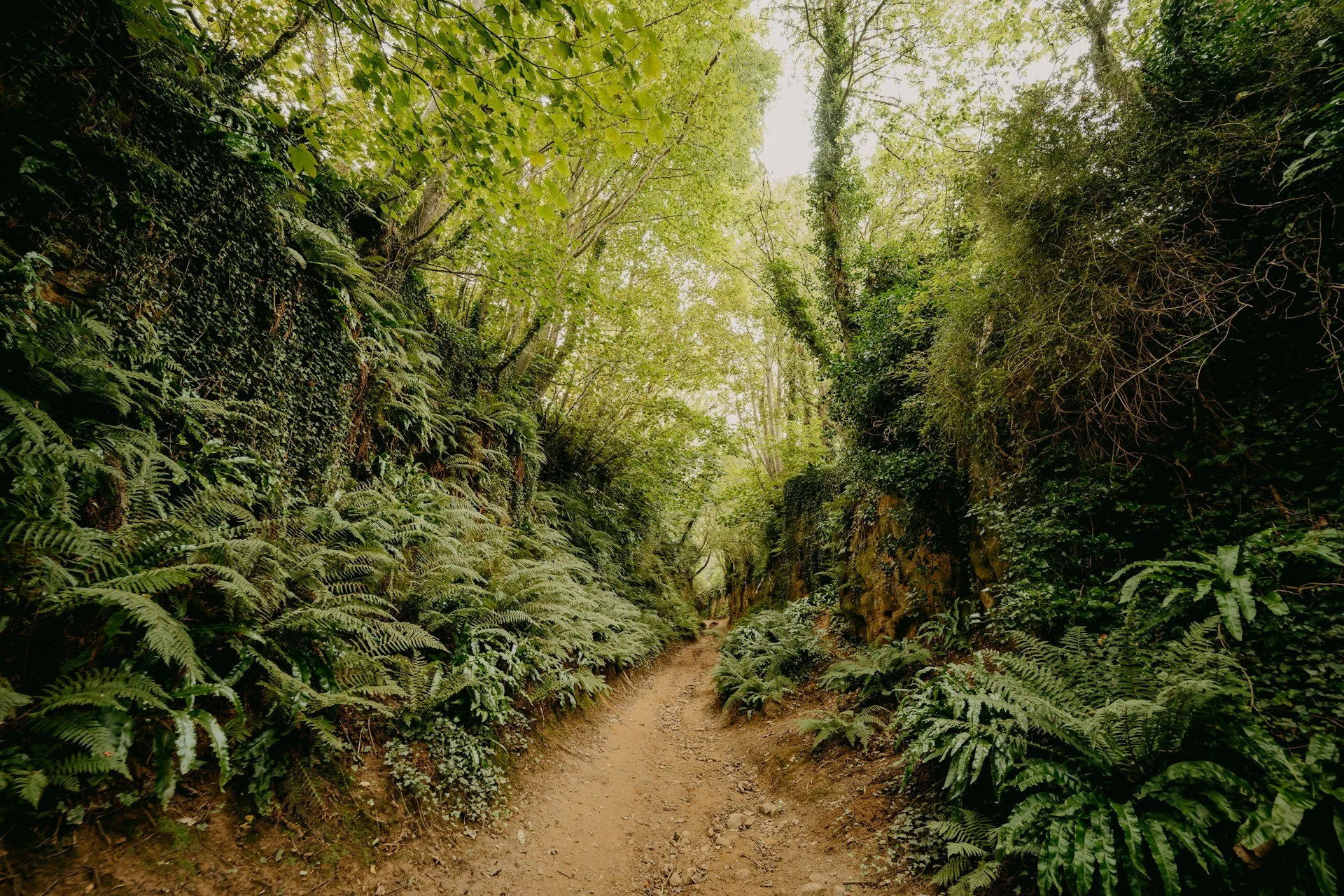 Photo by Annie Spratt on Unsplash
1. WHAT IS A HOLLOWAY?
A holloway is a pathway created by time and use to form an entrenched furrow. As the name suggests, it’s a “hollow way”, worn into the countryside until it becomes a sunken path. Called ‘hola weg’ by our Anglo-Saxon ancestors (‘Hohlweg’ in modern German), the first recorded use of the more familiar Holle Way in English dates from 1475[1]. In French, the term is the same, “chemin creux”.
2. HOW IS A HOLLOWAY FORMED?
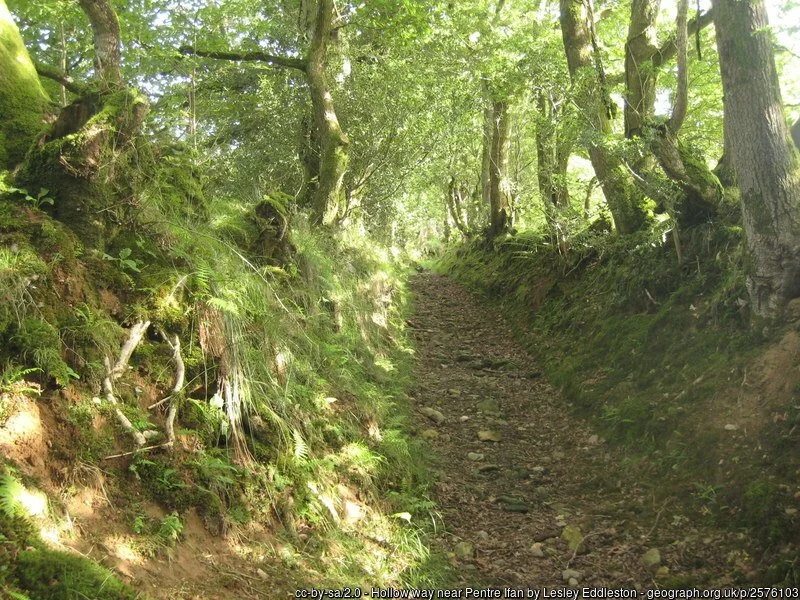 Hollow way near Pentre Ifan, Pembrokeshire for SN0937 © Lesley Eddleston. Licensed for reuse under this Creative Commons Licence
Holloways aren’t deliberately constructed paths. Instead, they’re formed from a combination of natural erosion, along with animal and human activity over hundreds of years. The conditions have to be right, though. Usually holloways form in areas of soft bedrock. Sandstone or chalk, for example, are easily eroded to form sunken pathways. Very unlike the much harder rock that’s usually typical here in Wales. A Holloway often starts in places where the ground slopes and water can run off, causing erosion. Over time, animals and people use the same path and gradually feet, hooves and wheels wear a groove. This channels more rainwater and more erosion takes place. The depth of the eventual Holloway depends on all these factors.
3. WHY ARE HOLLOWAYS HISTORICALLY SIGNIFICANT?
In recent years, there’s been more interest in the idea that paths such as holloways are as historically important as buildings and artefacts. It makes sense. Historical paths like this often reveal direct routes between ancient settlements and tell us stories about daily life in the past that might otherwise be lost. They show us where trade routes were between towns and villages, sometimes linking to wider networks across countries. And because holloways can be quite deep, the traces of these ancient paths remain where paths on harder bedrock grow over and are lost to us.
Holloways have left their mark on our language too. ‘Holloway’ is still a common surname in English, as is ‘Hollweg’ in German. Maybe you’ve heard of Holloway Road in London, which many historians believe follows an ancient path driving cattle through modern-day Islington to market.
The topography of the semi-hidden paths, best known to locals, also made them useful hiding places in times of war. When the Guerres de Vendée counter-revolutionary battles took place during the French Revolution, locals were able to use their knowledge of the chemins creux to move freely from place to place, unknown to the revolutionary troops.
4. ECOLOGICAL SIGNIFICANCE OF HOLLOWAYS
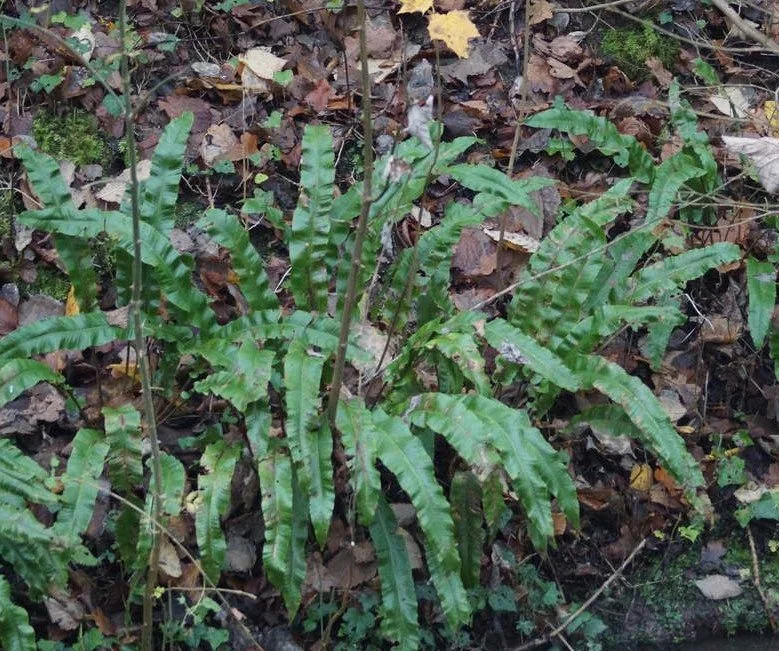 Hart’s Tongue Fern (Asplenium Scolopendrium)
Holloways are also ecologically significant. As the paths sink further below the surrounding countryside, and trees grow up to form a tunnel-like canopy, unique microclimates are created, that provide a habitat for rare flora and fauna.
‘Asplenium Scolopendrium’ or ‘Hart’s Tongue Fern’, for example, is an ancient species found in holloways in Dorset. Similarly, the luminous green ‘Schistostega pennata’, known as ‘Goblin’s Gold’, which lives particularly well in dim places on sandstone. (As an interesting aside for my linguist readers, while we call it ‘goblin’s gold’ in English, in Sweden the plant is known as ‘drakguldmossa’ or ‘dragon’s gold moss’.)
The dark and damp conditions are also ideal for fungi and insects, as well as for birds, such as the little brown dunnock. Insects also thrive, such as the solitary Mason bee, an important pollinator. Living alone, rather than in colonies, the mason bees’ burrows have been spotted in the soft walls of a number of UK holloways.
5. CHALLENGES AND CONSERVATION
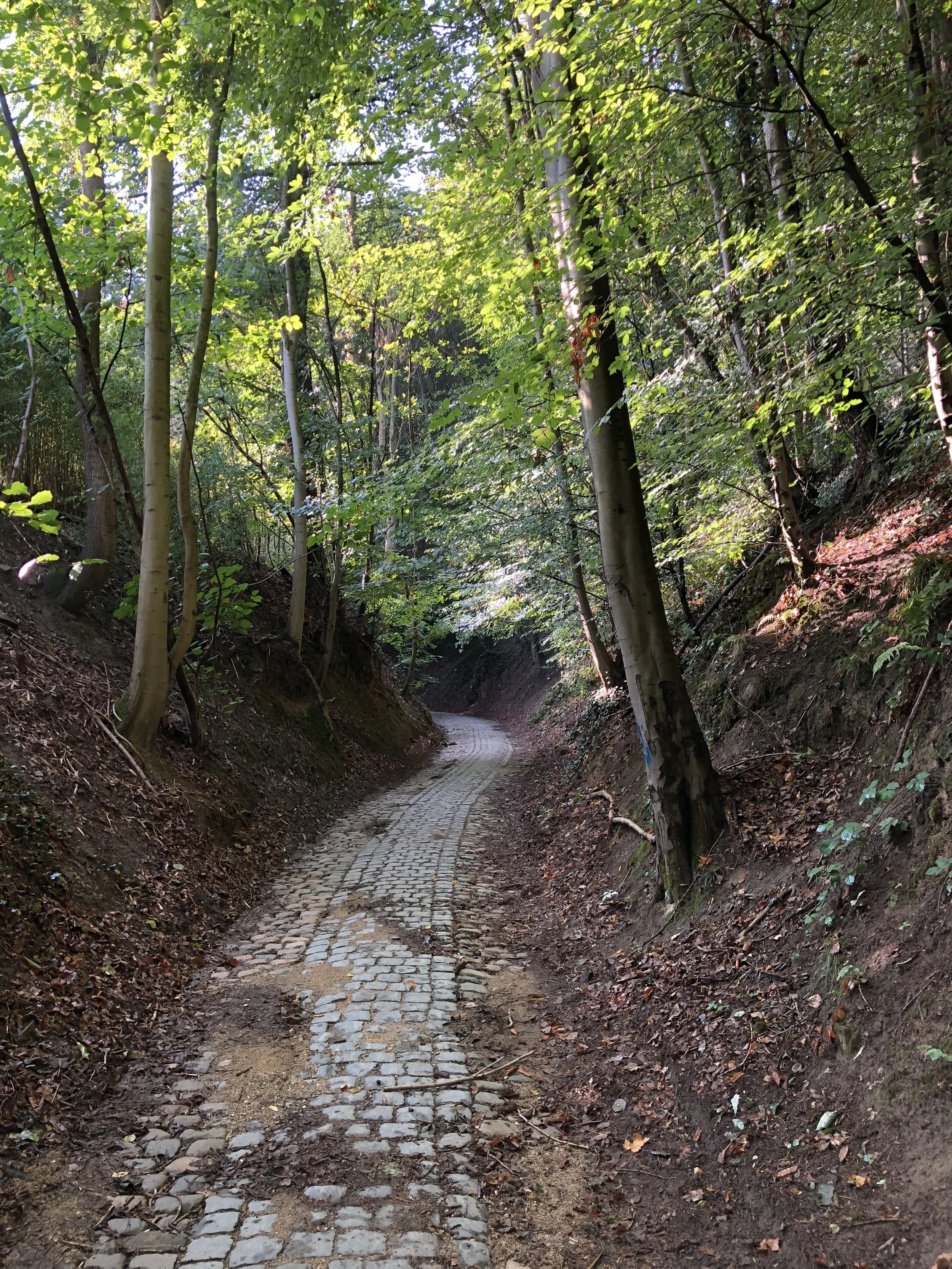 Crabbegat Holloway, Uccle, Belgium. © GdML CC BY-SA 4.0
Protecting holloways can be challenging. They are linear, crossing local authority boundaries, blurring the bureaucratic lines of who’s responsible for them. They’re often in isolated and harder to access locations. They’re not yet formally recognised as heritage sites.
The challenge lies in balancing preserving the holloways with allowing them to be used as they always were – keeping them accessible to the public, but protecting the history and unique ecology.
6. WHERE TO FIND A HOLLOWAY
If, like me, you’re inspired to immediately set off and explore one of these ancient sunken paths, a quick internet search will give you plenty of options. The UK’s best known holloways are probably in Dorset (Symondsbury and surroundings) and the South Downs (Petworth, Midhurst, Halnaker). But there are also other holloways around the UK and even some here in Wales, though the harder bedrock means they’re much shallower than many in the south of the UK.
In France, well-known examples are found at La Meauffe in Normandy, or at Bocage Bressuirais in Nouvelle-Aquitaine. Belgium has interesting holloways at Uccle in the greater Brussels area and at Bossut a little further east. There are many more, though, to discover and explore.
FINALLY…
As always, remember that the rules of respectful rambling apply. Enjoy walking the atmospheric holloways, but tread lightly and respect the fragile ecosystems so that they remain a part of our shared heritage for many generations to come.
[1] The Historical Thesaurus of English https://ht.ac.uk/
BIBLIOGRAPHY
Blipfoto. (2022). Hollow ways and hidden ways | ceridwen. [online] Available at: https://www.blipfoto.com/entry/3213912 [Accessed 27 Aug. 2024].
Historic England (2018) Pre-industrial Roads, Trackways and Canals: Introductions to Heritage Assets. Historic England. Swindon.
Leturcq, S. (2008). “Fonction et devenir d’un réseau invisible : les crêtes de labour dans les terroirs beaucerons (XIVe-XXe siècles)”. In Compatangelo-Soussignan R. et al. (eds.), Marqueurs des paysages et systèmes socio-économiques. Presses universitaires de Rennes, pp. 163-174.
Robert Macfarlane. (2008). Going to Ground: Britain’s Holloways. [Online]. Orion Magazine. Last Updated: 12 May 2008. Available at: https://orionmagazine.org/article/going-to-ground-britains-holloways/ [Accessed 28 August 2024].
Macfarlane, R., Donwood, S. and Richards, D. (2014) Holloway. London: Faber & Faber.
Macfarlane, R. (Auteur), Hersant, P. (Traduction) (2022) Par les chemins – Une histoire des routes et de ceux qui les ont empruntées. Paris: Les Arènes.
Office de Tourisme du Bocage Bressuirais, aux portes du Puy du Fou, une destination authentique, Vacances Nature et conviviales. (2017). Parcourir les chemins creux. [online] Available at: https://www.tourisme-bocage.com/explorer/parcourir-les-chemins-creux [Accessed 27 Aug. 2024].
Rio, Bernard (2005) La Bretagne des chemins creux. Editions Sud Ouest.


